Network Proposal 1 – Far Reach Bangui – Damara
Long-distance backhaul using high-gain point-to-point radio links (AF-5XHD + parabolic dishes), combined with K/H stations deployed along the main road axis. Distances are indicative (line of sight). Prices are given in THB.
Indicative conversion: 1 THB ≈ 18 CFA (XAF). Adjust according to the real exchange rate.
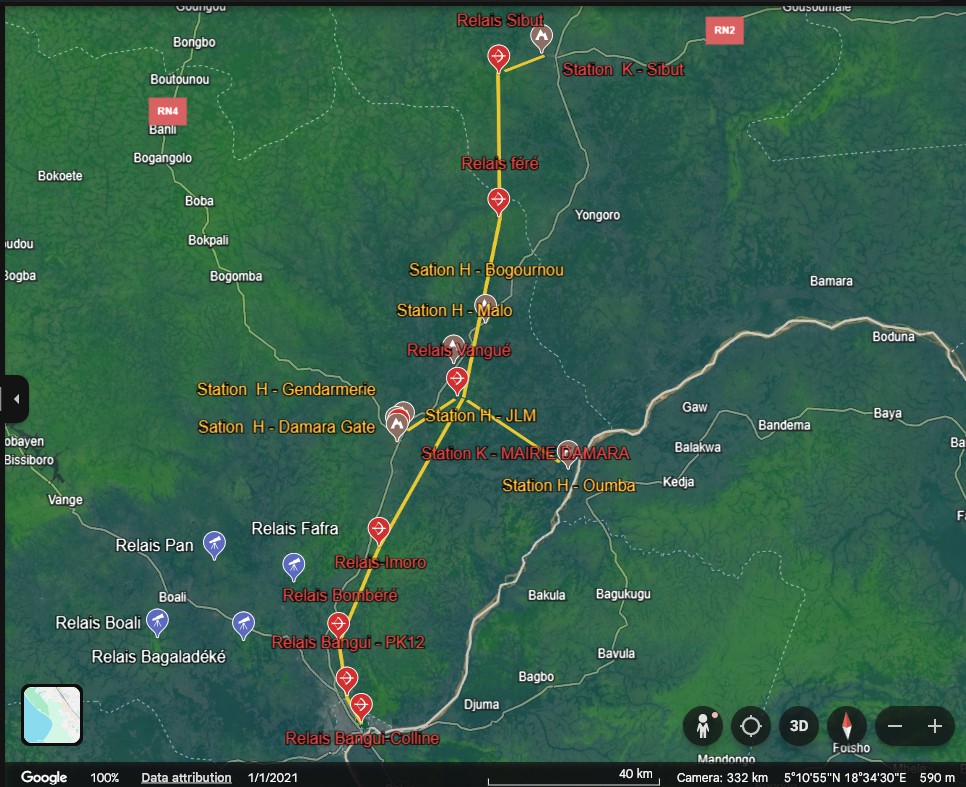
Bangui – Hill relay (0 km) – Core node, high RF pollution
Target distance: Backhaul departure toward PK12 (~7 km), urban area with hills and trees
| Backhaul: 2× airFiber 5XHD + 2× AF-5G34-S45 (Bangui – PK12, very high RF margin) | ฿40,000 / 720,000 CFA |
| Local / village exit: 1× airMAX PowerBeam 5AC 500 (~7 km) | ฿5,100 / 91,800 CFA |
| Switch / PoE + network cabinet (core site) | ฿8,000 / 144,000 CFA |
| Solar power: 3×100W panels + MPPT 30A + 2×100Ah GEL batteries | ฿14,000 / 252,000 CFA |
| Estimated total – Bangui Hill station | ฿67,100 / 1,207,800 CFA |
Bangui – PK12 relay (7 km)
Target distance: Urban hop Bangui–PK12 (~7 km) then relay toward Bombéré (~6 km). RF noise, partial obstacles.
| Backhaul: 2× airFiber 5XHD + 2× AF-5G34-S45 (Bangui – PK12 – Bombéré) | ฿40,000 / 720,000 CFA |
| Local exit / PK12: 1× airMAX PowerBeam 5AC 500 (PtP ~6–10 km) | ฿5,100 / 91,800 CFA |
| Local omni AP (nearby neighborhoods) | ฿3,000 / 54,000 CFA |
| Switch / PoE + cabinet | ฿6,000 / 108,000 CFA |
| Solar power: 3×100W + MPPT 30A + 2×100Ah GEL | ฿14,000 / 252,000 CFA |
| Estimated total – PK12 station | ฿68,100 / 1,225,800 CFA |
Bombéré relay (13 km)
Target distance: PK12 – Bombéré (~6 km) then Bombéré – Imoro (~10 km). Elevated point, open terrain.
| Backhaul: 2× airFiber 5XHD + 2× AF-5G34-S45 (PK12 – Bombéré – Imoro) | ฿40,000 / 720,000 CFA |
| Local omni AP (village coverage) | ฿3,000 / 54,000 CFA |
| Switch / PoE + cabinet | ฿6,000 / 108,000 CFA |
| Solar power: 3×100W + MPPT 30A + 2×100Ah GEL | ฿14,000 / 252,000 CFA |
| Estimated total – Bombéré station | ฿63,000 / 1,134,000 CFA |
Imoro relay (~23 km from Bangui)
Target distance: Bombéré – Imoro (~10 km) then Imoro – Vangué (~10 km). Clear hills.
| Backhaul: 2× airFiber 5XHD + 2× AF-5G34-S45 (Bombéré – Imoro – Vangué) | ฿40,000 / 720,000 CFA |
| Village exit / Imoro: 1× airMAX PowerBeam 5AC 500 (PtP ≤15 km) | ฿5,100 / 91,800 CFA |
| Local omni AP | ฿3,000 / 54,000 CFA |
| Power supply: Solar pack S3 (see table below) | ฿13,500 / 243,000 CFA |
Recommended PTP / backhaul equipment
| Equipment | Usage / range | Indicative price | Image |
|---|---|---|---|
| airFiber 5XHD PTP radio |
With 30–34 dBi dish: stable links up to 60 km | ฿8,000 / 144,000 CFA (per radio) | 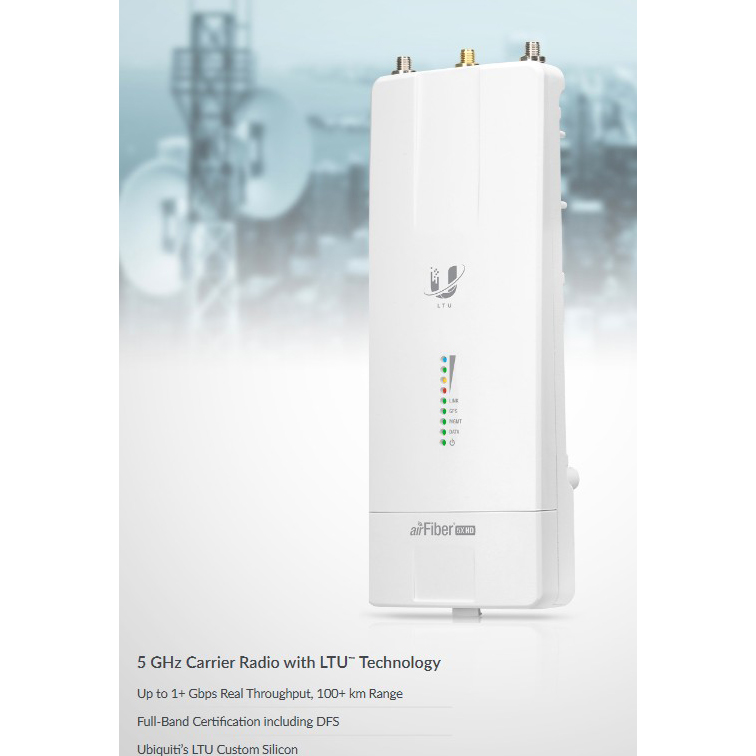 |
| AF-5G34-S45 34 dBi parabolic dish |
Long-distance PTP backbone | ฿12,000 / 216,000 CFA (per antenna) |  |
| RocketDish RD-5G31-AC | High-gain alternative dish | ฿15,900 / 286,200 CFA |  |
| airFiber conversion kit AF-5G-OMT-S45 | Adapts RocketDish to airFiber radios | ฿3,000 / 54,000 CFA | – |
Citizen stations
| Station | Description | Indicative cost |
|---|---|---|
| Station S Portable citizen unit |
ESP32-based device with 3.5″ SPI screen by default and 15-key keypad. Used for messaging, alerts, light documents, and opportunistic ferrying. | ฿1,010 / 18,180 CFA |
| Station S – option | 5″ detachable touchscreen on the opposite face for comfort usage, while keeping the physical keypad as a fallback. | ฿1,399 / 25,182 CFA |
| Station M Mobile (smartphone) |
Termux script or future APK. Messaging, health checks with K/H stations, and opportunistic ferry role. | – |
Standard solar power packs (mast excluded)
| Pack | Typical usage | Composition | Approx. price |
|---|---|---|---|
| S1 Light K/H station |
Low consumption, no Raspberry Pi |
1×100W panel PWM controller 20A 1×100Ah GEL battery Cables, fuses, enclosure |
฿5,500 / 99,000 CFA |
| S2 Standard K/H station |
1–2 radios + local AP |
2×100W panels PWM controller 1×100Ah GEL battery |
฿6,500 / 117,000 CFA |
| S3 Backbone relay |
airFiber + parabolic dishes |
3×100W panels MPPT controller 30A 2×100Ah GEL batteries |
฿13,500 / 243,000 CFA |
Operational notes
- Wood or bamboo masts are assumed and excluded from costs.
- Stations can be upgraded incrementally as traffic grows.
- Each relay can also act as a civic K-station when equipped with storage and signing keys.
Ubiquiti – operations and remote management
With Ubiquiti equipment (airFiber, airMAX, LTU), the entire backbone can be monitored and managed remotely:
- real-time link quality visualization,
- remote firmware upgrades,
- remote reboot and diagnostics,
- traffic flow per hop,
- alerting (email / messaging),
- centralized supervision via UISP / UNMS.
This allows full national-scale backbone management from Bangui, or remotely from abroad, without having to physically climb towers or hills for troubleshooting.