
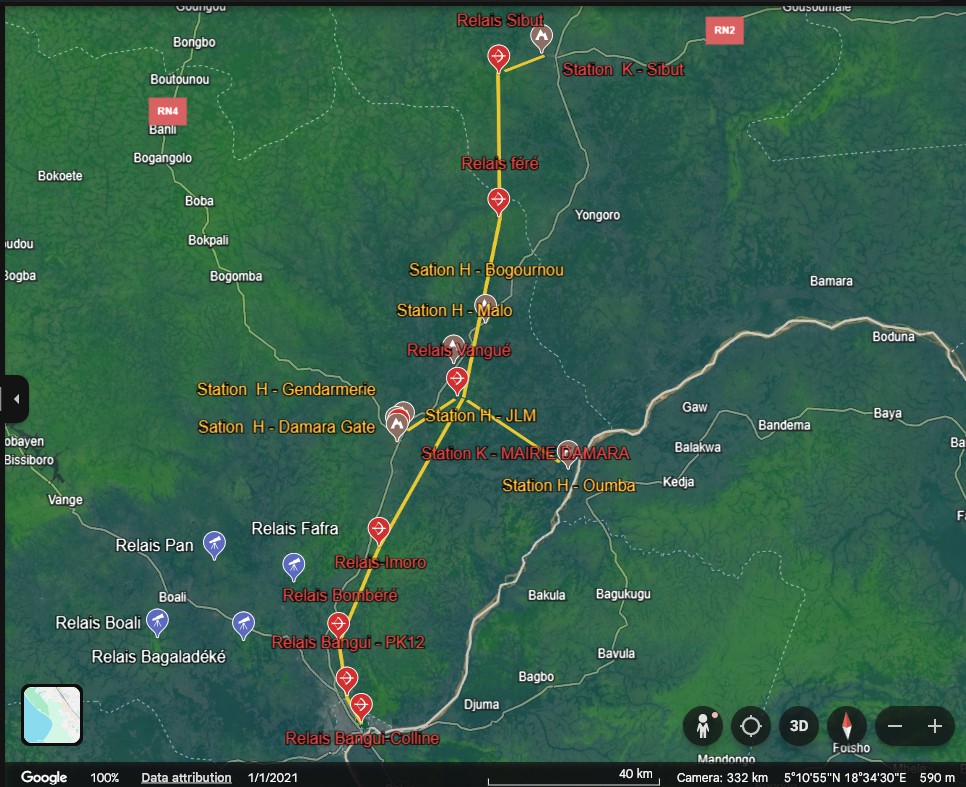
Relais Bangui - Colline (0 km) (Nœud central, pollution HF élevée)
Distance cible : Backhaul de départ vers PK12 (~7 km), zone urbaine, collines et arbres possibles
| Backhaul : 2 airFiber 5XHD + 2 AF-5G34-S45 (Bangui – PK12, très forte marge RF) | ฿40,000 / 720000 CFA |
| Sortie locale / village : 1 airMAX PowerBeam 5AC 500 (~7 km) | ฿5,100 / 91800 CFA |
| Switch/PoE + coffret réseau (site central) | ฿8,000 / 144000 CFA |
| Alimentation solaire : 3×100W + MPPT 30A + 2×100Ah GEL | ฿14,000 / 252000 CFA |
| Total estimatif station Bangui - Colline | ฿67,100 / 1207800 CFA |
Relais Bangui - PK12 (7 km)
Distance cible : Hop urbain Bangui – PK12 (~7 km) puis relais vers Bombéré (~6 km). Bruit HF, quelques obstacles possibles.
| Backhaul : 2 airFiber 5XHD + 2 AF-5G34-S45 (Bangui – PK12 – Bombéré) | ฿40,000 / 720000 CFA |
| Sortie locale / PK12 : 1 airMAX PowerBeam 5AC 500 (PtP ~6–10 km) | ฿5,100 / 91800 CFA |
| AP local/omni Ubiquiti (quartiers proches) | ฿3,000 / 54000 CFA |
| Switch/PoE + coffret | ฿6,000 / 108000 CFA |
| Alimentation solaire : 3×100W + MPPT 30A + 2×100Ah GEL | ฿14,000 / 252000 CFA |
| Total estimatif station PK12 | ฿68,100 / 1225800 CFA |
Relais Bombéré (13 km)
Distance cible : PK12 – Bombéré (~6 km) puis Bombéré – Imoro (~10 km). Point haut, terrain dégagé.
| Backhaul : 2 airFiber 5XHD + 2 AF-5G34-S45 (PK12 – Bombéré – Imoro) | ฿40,000 / 720000 CFA |
| AP local/omni Ubiquiti (village) | ฿3,000 / 54000 CFA |
| Switch/PoE + coffret | ฿6,000 / 108000 CFA |
| Alimentation solaire : 3×100W + MPPT 30A + 2×100Ah GEL | ฿14,000 / 252000 CFA |
| Total estimatif station Bombéré | ฿63,000 / 1134000 CFA |
Relais Imoro (≈23 km depuis Bangui)
Distance cible : Bombéré – Imoro (~10 km) puis Imoro – Vangué (~10 km). Collines dégagées.
| Backhaul : 2 airFiber 5XHD + 2 AF-5G34-S45 (Bombéré – Imoro – Vangué) | ฿40,000 / 720000 CFA |
| Sortie village / Imoro : 1 airMAX PowerBeam 5AC 500 (PtP ≤15 km) | ฿5,100 / 91800 CFA |
| AP local/omni Ubiquiti | ฿3,000 / 54000 CFA |
| Alimentation : Pack S3 (voir tableau ci-dessus) | ฿13,500 / 243000 CFA–14,000 |
Matériel PTP / backhaul recommandé
| Matériel | Usage / portée | Prix indicatif | Photo |
|---|---|---|---|
| airFiber 5XHD Radio PTP (LTU) |
Avec parabole 30–34 dBi : 60 km stable avec 31–34 dBi | ฿8,000 / 144000 CFA / radio | 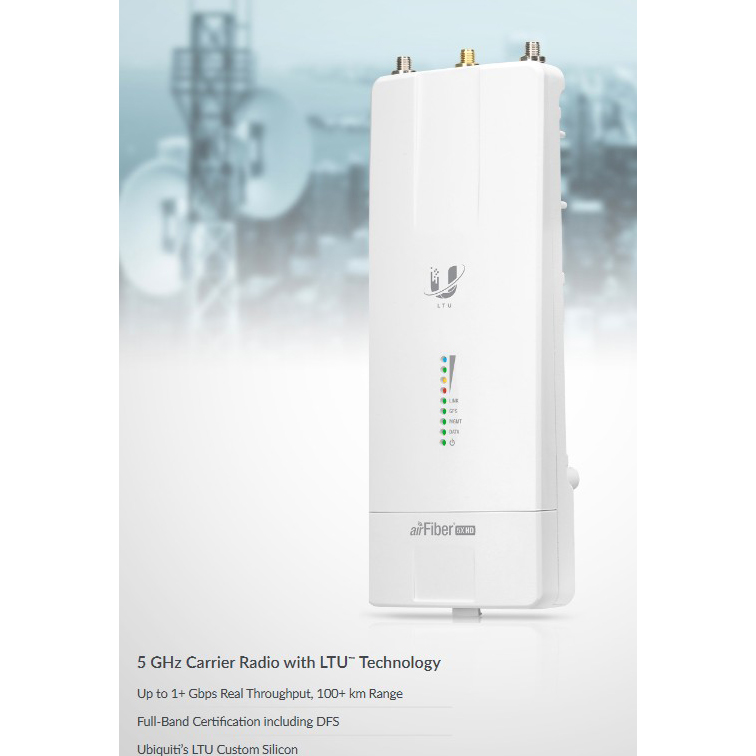 |
| AF-5G34-S45 Antennes paraboliques 34 dBi |
PTP longue distance | ฿12,000 / 216000 CFA / antenne |  |
| RocketDish RD-5G31-AC Antennes (compatible avec kit) 31 dBi |
PTP longue distance | ฿15,900 / 286200 CFA / antenne |  |
| airFiber Conversion kit AF-5G-OMT-S45 |
Pour adapter RocketDish à airFiber | ฿3,000 / 54000 CFA | – |
| Kit solaire + batterie + mât | Alimentation autonome | ฿25,000 / 450000 CFA | – |
| STATION S – Boîtier citoyen (portable) | |||
| ESP32 (Station S) + écran 3.5″ SPI par défaut + clavier 15 touches | Messagerie / fichiers légers, alerte, affichage compact | ฿1,010 / 18180 CFA (ESP32 350 + écran 540 + clavier 120) | – |
| Option : écran tactile 5″ (sur l’autre face, détachable) | Mode confort (saisie tactile, lecture), conserve le clavier 15 touches en secours | ฿1,399 / 25182 CFA | – |
| GY-302 BH1750FVI (capteur lumière ambiante I2C) | Ajuste automatiquement la luminosité du rétroéclairage selon la lumière ambiante | ฿50 / 900 CFA | – |
| STATION M – Mobile (smartphone) | |||
| Application mobile (Termux script, futur APK) | Messagerie/healthcheck vers Station K/H ; peut servir de ferry opportuniste | – | – |
| Option clavier tactile | Clavier logiciel (2.8–5″) pour saisie rapide ; garder 15 touches physiques en secours | – | – |
| BACKHAUL PRINCIPAL (Bangui – PK12 – Bombéré – Imoro – Vangué) | |||
Packs solaires standard (sans coût de mât – bambou / arbres locaux)
| Pack | Usage type | Composition | Prix approx. |
|---|---|---|---|
| Pack S1 Petit relais / Station K light |
- 1 PowerBeam ou CPE - 1 Station K light (ESP32 + LCD) - Faible conso, pas de RPi |
- 1 panneau 100W 12V mono (~฿700 / 12600 CFA) - 1 contrôleur PWM 20A 12/24V (~฿250 / 4500 CFA) - 1 batterie GEL 12V 100Ah (~฿4,200 / 75600 CFA) - Câbles + fusibles + boîtier (~฿400 / 7200 CFA) |
฿5,500 / 99000 CFA |
| Pack S2 Relais H / petite Station K full |
- 1–2 radios (PowerBeam 500/620) - 1 AP local - 1 Station K un peu plus fournie - Conso moyenne |
- 2 panneaux 100W 12V (≈200W, ~฿1,400 / 25200 CFA) - 1 contrôleur PWM 20A (~฿250 / 4500 CFA) - 1 batterie GEL 12V 100Ah (~฿4,200 / 75600 CFA) - Câbles + fusibles + boîtier (~฿500 / 9000 CFA) |
฿6,500 / 117000 CFA |
| Pack S3 Gros relais backhaul (AF-5XHD + 34 dBi) |
- 1 lien airFiber 5XHD (ou 2 côtés au même site) - 1 AP local + 1 PowerBeam branché - Conso plus élevée, besoin de marge pluie |
- 3 panneaux 100W 12V (≈300W, ~฿2,100 / 37800 CFA) - 1 contrôleur MPPT 30A correct (~฿2,500 / 45000 CFA) - 2 batteries GEL 12V 100Ah (~฿8,400 / 151200 CFA) - Câbles + fusibles + boîtier (~฿800 / 14400 CFA) |
฿13,500 / 243000 CFA–14,000 |
Station K Damara (≈10 km de Vangué)
Distance cible : Branche Vangué – Damara (~10 km). Station K simple, sans RPi backhaul.
| Backhaul branche : 1 airMAX PowerBeam 5AC 620 (29 dBi, vers Vangué, ~10 km) | ฿7,000 / 126000 CFA |
| Boîtier Station K light (ESP32 + LCD + SD, cam légère + micro) | ฿1,800 / 32400 CFA–2,200 |
| Alimentation : Pack S1 (voir tableau ci-dessus) | ฿5,500 / 99000 CFA |
Relais Imoro (≈23 km depuis Bangui)
Distance cible : Nœud backbone : PK12 – Bombéré – Imoro – Vangué, collines dégagées.
| Backhaul principal : 2 airFiber 5XHD + 2 AF-5G34-S45 (Bombéré – Imoro – Vangué) | ฿40,000 / 720000 CFA |
| Sortie village / Imoro : 1 airMAX PowerBeam 5AC 500 (PtP ≤15 km) | ฿5,100 / 91800 CFA |
| AP omni/routeur local (Ubiquiti) | ฿3,000 / 54000 CFA |
| Alimentation : Pack S3 (voir tableau ci-dessus) | ฿13,500 / 243000 CFA–14,000 |
Station H village (relais court)
Distance cible : Petit saut 5–10 km entre deux villages, 1 lien PowerBeam + 1 AP local.
| Backhaul : 1 airMAX PowerBeam 5AC 500 (27 dBi, 5–10 km) | ฿5,100 / 91800 CFA |
| AP local/omni (Ubiquiti airMAX/UniFi) | ฿3,000 / 54000 CFA |
| Alimentation : Pack S2 (voir tableau ci-dessus) | ฿6,500 / 117000 CFA |
Ubiquity:
- see link quality in real time,
- update firmware remotely,
- reboot radios,
- view signal graphs,
- detect failures,
- follow traffic flow per hop,
- monitor throughput on each direction,
- receive alerts (email/SMS/Telegram), - run diagnostics,
- trace bottlenecks,
- visualize the entire backbone live on a map.
- This is exactly what UISP / UNMS is made for.
1. You get a complete live map of your entire backbone
UISP shows:
- All relays (PK12, Bombéré, Imoro, Damara Gate…)
- All links (PTP1, PTP2, PTP3…)
- Color-coded link health
- - Traffic in both directions
- Alerts when even one tiny thing goes wrong
You literally see:
green – OK
orange – warning (signal drop, noise, weather)
red – link down
- You can manage your whole country-wide network from one screen.
2. Remote management features (no need to climb the hills)
Every Ubiquiti radio (airFiber, LTU, airMAX) supports:
- Remote WebUI access
- Remote SSH
- Remote config backup/restore
- Remote firmware upgrade
- Remote antenna alignment tool
- Real-time spectrum analyzer (remote!)
- Remote link quality / SNR graphs
- Remote logs
You only need:
- a management network (simple VLAN or flat network)
- one UISP controller (can be on a Raspberry Pi, a small VM, or in the cloud)
3. Remote OAM (Operations, Administration, Maintenance)
With Ubiquiti airFiber / LTU, you can:
- Identify problems remotely:
- bad alignment
- water in cable
- power issues
- interference
- fading due to weather
- hardware aging
- speed degradation
Fix problems remotely:
- change channels
- change power
- lock modulation
- adjust bandwidth
- reboot remotely
- switch link mode (SERIAL / SISO / MIMO)
- No climbing.
- No travel.
- You control the entire national backbone from Bangui or from Thailand if you want.
4. Traffic management from one central point
UISP gives:
- per-hop bandwidth
- real-time throughput graphs
- per-site latency
- packet loss
- link utilization
- queue monitoring
- interface stats
- alerts when traffic spikes or drops
- historical graphs (hour / day / week / month)
- You have a full NOC dashboard.
5. Two ways to operate “remote management” in CAR
Option 1 – Local UISP server in Bangui
- Run it on a small server or Raspberry Pi
- All radios report to it
- Accessible via VPN
Option 2 – Cloud UISP (recommended for you)
- Install UISP on a cloud server (DigitalOcean / AWS)
- All radios in CAR report to it
- You manage everything from C.A.R., Thailand or France (travelling)
- No central hardware
- Independent of local power cuts
Possible to install a small “station K mini-NOC” at each relay with Raspberry Pi for even more visibility